
When Government Becomes God
The Chilling Warning Clarence Thomas Gave Texas About America’s Forgotten Truth

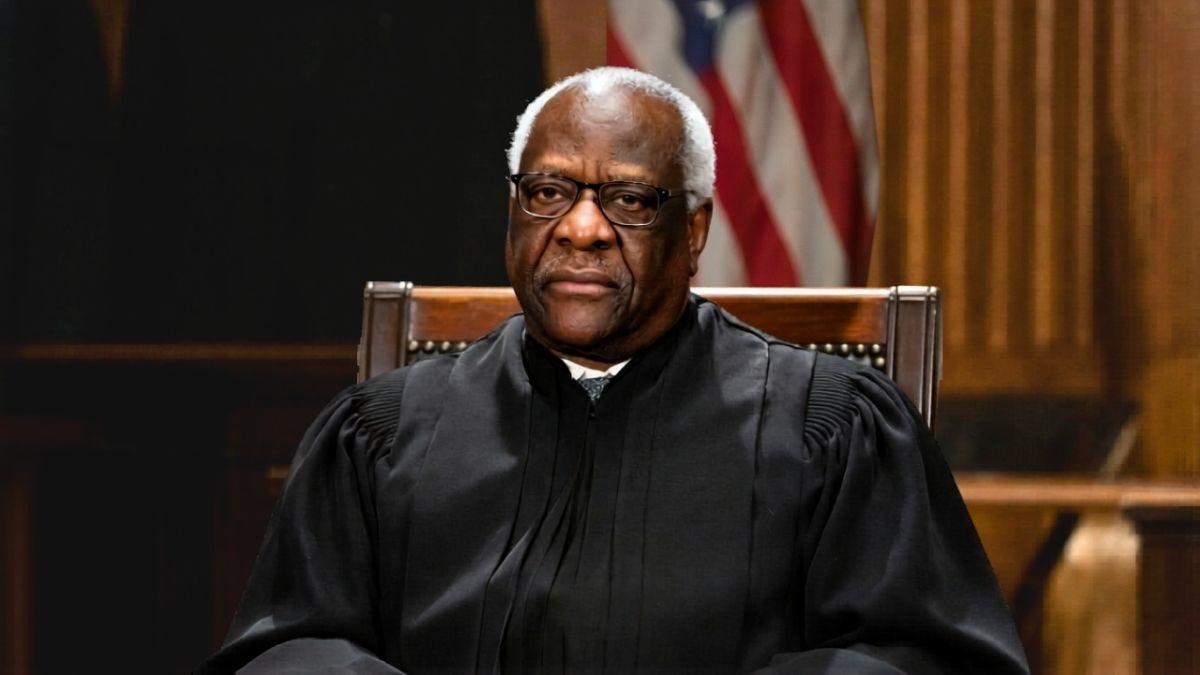
On April 15, 2026, Supreme Court Justice Clarence Thomas stood before students at the University of Texas at Austin and delivered what may be the most important speech of his career. He wasn’t arguing a case. He wasn’t writing an opinion. He was doing something rarer in Washington: telling the truth plainly, without flinching.
He was there to celebrate the 250th anniversary of the Declaration of Independence. And he warned us that its core idea—the one idea everything else rests on—is under serious threat.1
The Most Dangerous Question in American Politics
Here’s the question at the center of everything: Where do your rights come from?
Your answer determines what kind of government you believe in. It determines how free you actually are. And it determines whether those rights can be taken away.
Justice Thomas grew up understanding this, not as theory but as lived truth. Raised in Pin Point, Georgia—a tiny, impoverished community outside Savannah—he came of age during Jim Crow, where the law itself was often the instrument of injustice. His grandfather taught it. His Irish immigrant nuns taught it. The message was clear and unbreakable.
“In God’s eyes and under our Constitution, we are equal,” Thomas recalled.
The Declaration of Independence gives a clear answer. Your rights come from your Creator—before any government ever existed, before any law was written, before any election was held. The document says plainly that all men are created equal, endowed by their Creator with certain unalienable rights, and that to secure these rights, governments are instituted among men, deriving their just powers from the consent of the governed.2
That’s not a minor point. That’s the whole foundation.
The Competing Vision of Human Rights
For most of American history, that foundation went largely unchallenged. Then, at the turn of the 20th century, a new philosophy entered the mainstream. It was called progressivism—and it was imported, not homegrown.
Thomas traced it directly to Woodrow Wilson, America’s 28th president. Wilson openly admired Germany’s model of centralized state power—and called it “nearly perfected.” He described the American system as “slow to see” the supposed superiority of European government. He dismissed the idea of individual natural rights as, in his words, “a lot of nonsense.”
American philosopher John Dewey argued the same: that the Founders’ ideas were historically limited—useful in their time, but now expired. The people, they said, should be guided by trained experts, not protected by outdated notions of God-given liberty.
The shift sounds academic. It isn’t.
“Progressivism seeks to replace the basic premises of the Declaration of Independence, and hence our form of government. It holds that our rights and our dignities come not from God, but from the Government.”3
What Happens When Rights Become Permissions
Stop here. This is the pivot point of the whole argument.
The difference between “God gives rights” and “government gives rights” is not a theological debate for seminaries. It is a practical, political, and deeply personal one.
If your rights precede the government—woven into your nature as a human being—then government’s job is simply to protect them. It has no authority to redefine or revoke them. The Declaration is explicit: governments exist to secure rights that already exist. The Constitution then structures how that protection works: it separates powers, divides authority between states and the federal government, and builds in specific protections for individual liberty.
But if government is the source of rights, then rights are permissions. They can be expanded. They can be narrowed. They can be revoked entirely—whenever the experts in charge decide that “progress” demands it.
Justice Thomas knows what that logic produces. He grew up under it.
The Human Cost of Disregarding the Declaration
Thomas didn’t argue from theory alone. He brought history—including his own Court’s shameful record.
He pointed to Plessy v. Ferguson, the 1896 Supreme Court decision that upheld Louisiana’s racial segregation law. The majority ruled that “separate but equal” accommodations were constitutionally reasonable in light of the “established usages, customs, and traditions of the people.” Nine justices dressed it in legal language, endorsed a racial caste system—and let it stand for sixty years.
There was one Justice who got it right. In his lone dissent, Justice John Marshall Harlan wrote that the Louisiana statute was inconsistent with the personal liberty of citizens, white and black, and hostile to both the spirit and the letter of the Constitution. He declared that the Constitution is color-blind, and neither knows nor tolerates classes among citizens. 4 5
Thomas honored that dissent—and condemned the majority’s cowardice. What stopped them wasn’t ignorance. It was fear: fear of political fire, fear of bad press, fear of where the logic of equality might lead. Sixty years of Jim Crow followed.
Thomas didn’t stop at the courtroom. He widened the lens—from the Jim Crow South to the fascist capitals of Europe—to show that the same logic, scaled up, produced its worst possible results.
He pointed to the progressive embrace of eugenics—the idea that science had proven racial hierarchies, and that the state should act on them. The Supreme Court endorsed it. In Buck v. Bell (1927), Justice Oliver Wendell Holmes wrote for an 8-1 majority that the state could forcibly sterilize citizens it deemed unfit—a ruling that has never been formally overturned.
And he pointed to the 20th century’s deadliest chapters: the fascist governments of Europe, the Soviet Union, Maoist China—each claiming to act in the name of historical progress, each dismissing natural rights as obstacles, each killing tens of millions of their own people.6
Critics have argued Thomas drew these historical lines too directly. The details of each movement may differ—but the pattern they share does not.
Wilson had called Germany’s system “nearly perfected.” The century that followed showed exactly what that meant.
The Character Crisis Beneath the Political Chaos
The speech was never primarily a political argument. At its heart, it was a call to courage.
Thomas returned again and again to the final sentence of the Declaration—the part most people forget. After all the soaring language about equality and unalienable rights, fifty-six men signed their names to a document the British Crown considered treason. They pledged to each other their lives, their fortunes, and their sacred honor—with a firm reliance on the protection of Divine Providence.
They could have been hanged. They signed anyway.
Thomas contrasted that courage with what he has witnessed across 47 years in Washington. People who know what’s right but won’t say it. Officials who fold when criticism arrives. Justices who allowed injustice to stand for sixty years because doing right was inconvenient. He named no names. He didn’t need to.
“Until we find a devotion that matches the courage of those who made this country possible,” he said, “I doubt any amount of study or development of insights about our Constitution will make much of a difference.”
That sentence deserves to land hard. Let it.
What’s Actually at Risk
This is not an academic dispute. Three things are genuinely at stake:
The source of rights. If Americans quietly accept that rights flow from government, every liberty becomes negotiable—on someone else’s schedule.
The function of the Constitution. As Thomas made clear, the Declaration is the mission statement, and the Constitution is the operating manual. Get the mission statement wrong, and everything else fails—the operating manual becomes a tool for whoever holds power.
The habit of courage. Cowardice, like courage, becomes habit. A generation that learns to stay quiet—to avoid criticism, protect careers, and conform to prevailing opinion—will not suddenly find backbone when it matters most.
How Free People Keep Freedom Alive
The levers are real and personal:
Know the argument. You cannot defend what you cannot explain. The Declaration says rights come from God, not government. That means no government can take them away—and any that tries has lost its legitimate authority.
Say it out loud. In classrooms, at school board meetings, in conversations with neighbors. The Declaration’s principles were not kept alive by scholars. They were kept alive by ordinary people—who believed them.
Refuse comfortable silence. Thomas cited a definition often attributed to FDR: courage is not the absence of fear, but the judgment that something else matters more than fear.
The Declaration was not written for a museum. It was written for free people willing to act like it.
“And for the support of this Declaration, with a firm reliance on the protection of Divine Providence, we mutually pledge to each other our Lives, our Fortunes, and our Sacred Honor.”
That pledge was made once. Every generation has to decide whether to renew it.
This one included.
Justice Clarence Thomas, “Remarks on the 250th Anniversary of the Declaration of Independence,” University of Texas at Austin, April 15, 2026. Published by Civitas Institute. civitasoutlook.com (Primary source: full speech transcript)
National Archives, Declaration of Independence—Primary Transcription. archives.gov/founding-docs/declaration-transcript (Primary source: the original document)
Liam Harrell, “Justice Clarence Thomas and the Enduring Creed of the Declaration of Independence,” American Center for Law and Justice, April 28, 2026. aclj.org/supreme-court/justice-clarence-thomas…
National Archives, Plessy v. Ferguson (1896)—Milestone Document with Harlan Dissent. archives.gov/milestone-documents/plessy-v-ferguson (Primary source: Supreme Court ruling and dissent)
Library of Congress, U.S. Reports Vol. 163, Plessy v. Ferguson—Full Harlan Dissent (PDF). tile.loc.gov — usrep163537.pdf (Primary source: original Supreme Court opinion)
Speech Video—Justice Clarence Thomas, Remarks at UT Austin, April 15, 2026. youtube.com/watch?v=iXijcySC0ZU (Video record of delivered remarks)