
The Day AI Stopped Asking Permission
Everyone knows the technology is in the room. Almost no one has decided what role it should play.


Sometime in the last two years, artificial intelligence went from something you chose to something you have. I’ve spent months writing about what that means. One pattern sits under all of it.
The False Choice You Were Handed
Start with what actually happened. AI never asked permission. It showed up in your inbox, your search bar, your phone, your kid’s homework. You didn’t sit down one morning and decide to let it in. It was already there.
Now notice how you’re told to feel about that. The story comes with two endings. Either AI makes you faster, smarter, and richer—or it takes your job, your privacy, and your mind. Adopt or be left behind. Resist or be replaced. Pick a side.
Both sides quietly agree on one thing: the machine sets the terms, and you react.
The threat was never the technology. It’s the posture.
How the Drift Happens
Every tool you accept without deciding is a small piece of authorship you hand away. It rarely feels like a decision, because it isn’t loud. This is how most erosion works. A republic doesn’t fall in an afternoon. It drifts, one relabeled default at a time, each one harder to notice the longer it sits there. Your own agency goes the same way, not in a single surrender, but in a hundred small conveniences you never stopped to weigh.
Convenience works like a current. It doesn’t announce where it’s taking you. It just pulls, quietly, toward whatever was easiest to click.
Watch It Reach Your Front Door
And this is measurable. In about a year, the share of organizations regularly using generative AI nearly doubled, from 33% to 65%. By 2025, it reached 79%.1 The institutions built to oversee it—Congress, regulators, the courts—still move in years, while adoption across government, healthcare, and finance moves in quarters. I laid the numbers out in The Speed Gap, and that gap has already reached your front door.
AI now weighs your credit. It sits inside the prior-authorization process that decides whether your insurance covers a procedure. A denial you never see the reasoning behind is still a denial. It curates the news you read and the feed your kids scroll. The standards behind those decisions were set by procurement and administrative memos, not by public debate.
Who wrote them? By what authority? Accountable to whom?
The Work Starts With You
Here is the part that changes everything. You cannot decide how AI fits your life if you’ve never named how you relate to it. Sovereignty is not a feeling about technology. It’s a practice—the daily choice to see what is in front of you instead of what you are told to see.
And you rarely see what cost you nothing.
So the work starts with you, not the tool. Before you can set a single standard for how AI operates in your life, you have to see where you already stand: your instincts, your habits, the lines you’ve drawn without writing them down.
Know Where You Stand
I built something to make that visible. I needed it first.
The AI Archetype™ is a free, five-minute assessment for principled, non-technical people who want to engage with AI deliberately instead of by default. It measures two things almost nobody has named for themselves: how you engage with AI, and how much you author the terms. Where those two lines cross, you land in one of eight types—from the Observer, who watches while the defaults get written, to the Architect, who claims the tools on their own terms.
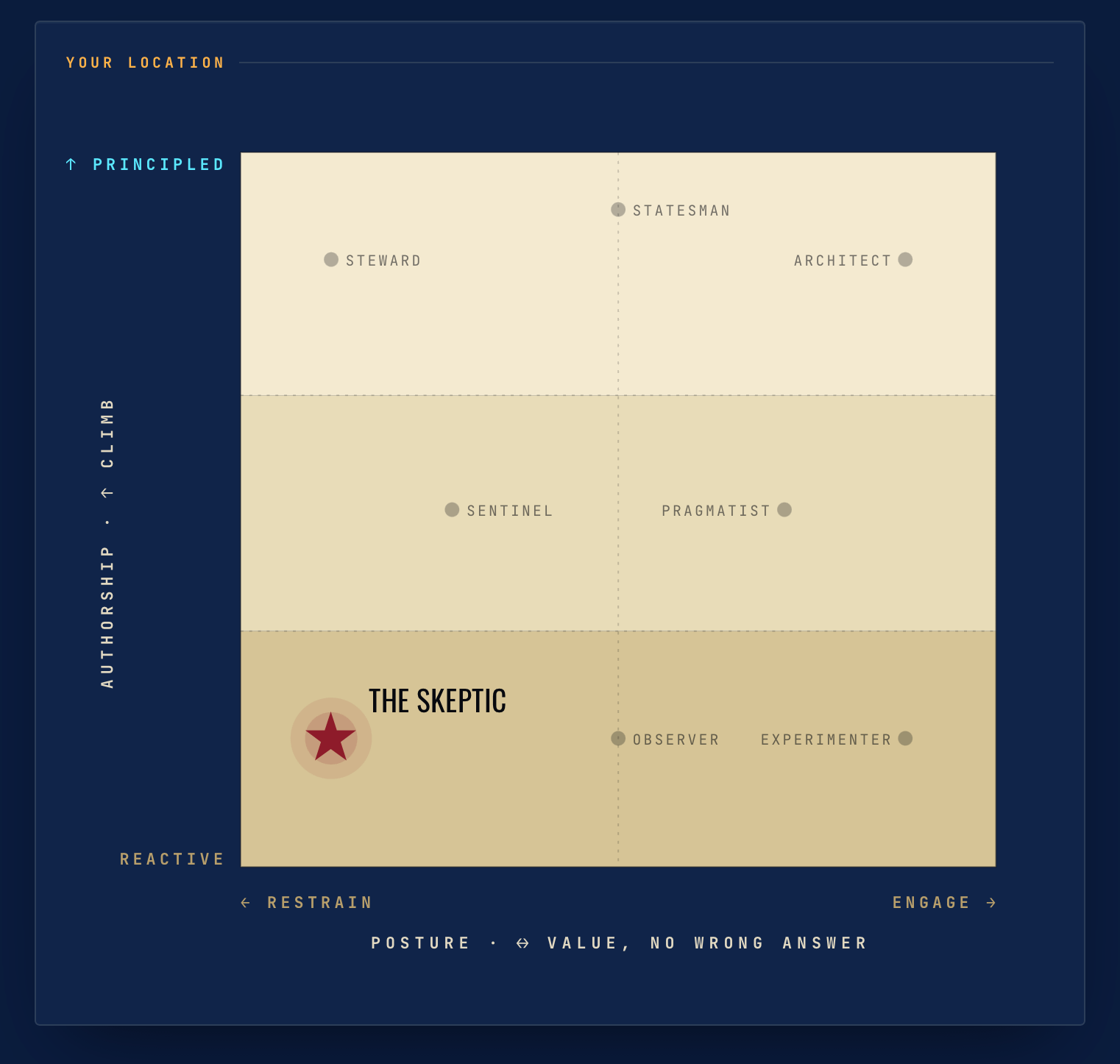
The moment you finish, you get a personalized minibook built around your result. Inside: your specific advantage, the blind spot most likely to cost you downstream, and a single question worth sitting with. Think of it as a mirror you can act on.
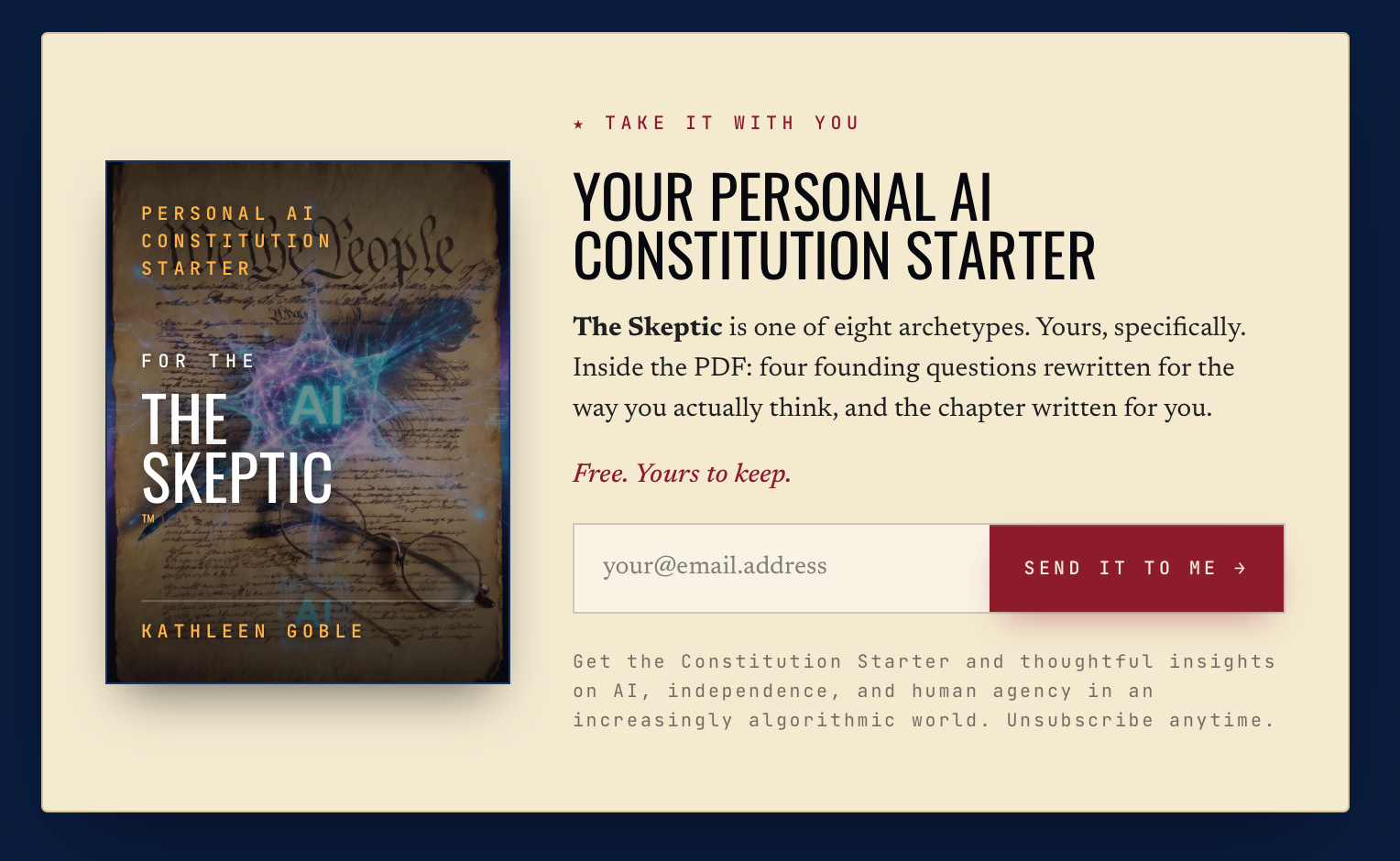
It also points you forward. Each result names your next step: the exact chapter written for where you stand, so you finish knowing exactly where to begin.
Because your starting posture is the first standard you set. Every rule you write after it is built on top.
One reader—a fellow builder on X—put it better than I could:
“Kathleen Goble has devised a useful thought exercise for everyone seeking to understand human autonomy and AI’s perceived threats or benefits. Know yourself first is an outstanding first step.”
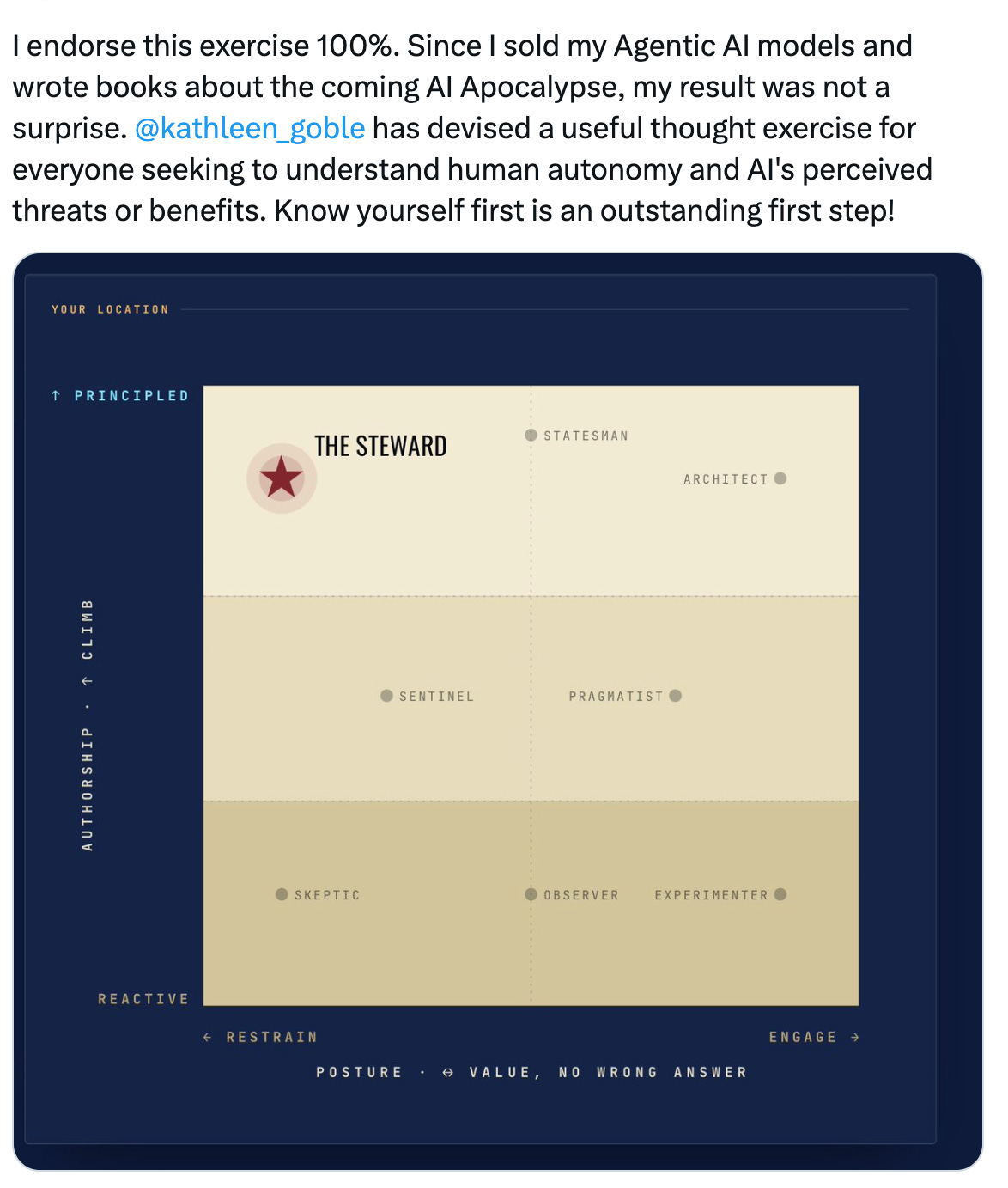
Know yourself first. Then decide—deliberately, the way free citizens decide everything that matters.
Take the free AI Archetype assessment → https://kathleengoble.com/archetype
Endnote
McKinsey & Company, McKinsey Global Surveys on the state of AI, 2017–25, mckinsey.com. Regular use of generative AI in at least one business function rose from 33% of organizations (2023) to 65% (2024) to 79% (2025).